
Personalized Floor Mats: 7 Ways to Brand Your Space in 2026

Table of Contents
- Why Personalized Floor Mats Matter More Than You Think {#why-personalized-floor-mats-matter}
- What Types of Personalized Floor Mats Are Available? {#what-types-are-available}
- How Do You Design a Custom Floor Mat With Your Logo? {#how-do-you-design-one}
- What's the Best Material for a Personalized Floor Mat? {#whats-the-best-material}
- How Long Do Personalized Floor Mats Last? {#how-long-do-they-last}
- The Hidden ROI: Safety, Cleaning Costs, and Brand Value {#the-hidden-roi}
- Indoor vs. Outdoor: Which One Do You Need? {#indoor-vs-outdoor}
- FAQ
- Sources
Personalized floor mats are custom-printed mats that display your logo, artwork, or branding right at your entrance or point of sale. They pull double duty: protecting your floors and reducing slip hazards while making a strong first impression on every person who walks through your door.
If you've been treating your entrance mat like an afterthought, that's about to change.
Quick Summary:
- Personalized floor mats combine safety, cleanliness, and branding in one product
- They work for businesses, schools, hotels, churches, and retail stores
- High-definition printing (like Mylogomat's UltraPrint) gives you crisp, photo-quality logos
- A quality commercial mat lasts 3 to 5 years, often costing less than $0.10 per day
- The right mat depends on location (indoor vs. outdoor), traffic volume, and your artwork
Table of Contents
- Why personalized floor mats matter more than you think
- What types of personalized floor mats are available?
- How do you design a custom floor mat with your logo?
- What's the best material for a personalized floor mat?
- How long do personalized floor mats last?
- The hidden ROI: safety, cleaning costs, and brand value
- Indoor vs. outdoor: which one do you need?
- FAQ
Why Personalized Floor Mats Matter More Than You Think {#why-personalized-floor-mats-matter}
Picture this: a customer walks up to your front door. Before they touch the handle, before they see your displays or your staff, they step on your mat. That mat is the first branded thing they physically interact with, and it happens within the first 7 seconds of their visit, which, not coincidentally, is exactly how long it takes someone to form a first impression of your business.
Most businesses miss this completely. They spend thousands on signage, social media ads, and interior design, then put a plain rubber mat at the door. It's like buying a great outfit and wearing mismatched shoes.
Your entrance is prime real estate. It's the one piece of "marketing" that every visitor literally touches. A personalized floor mat turns that overlooked patch of floor into a branded moment.
There's a real safety case here too. The National Floor Safety Institute reports that 85% of slip-and-fall accidents happen on wet surfaces, and OSHA estimates these injuries cost U.S. businesses over $70 billion per year. A good mat isn't just a nice visual. It's protective.
What Types of Personalized Floor Mats Are Available? {#what-types-are-available}
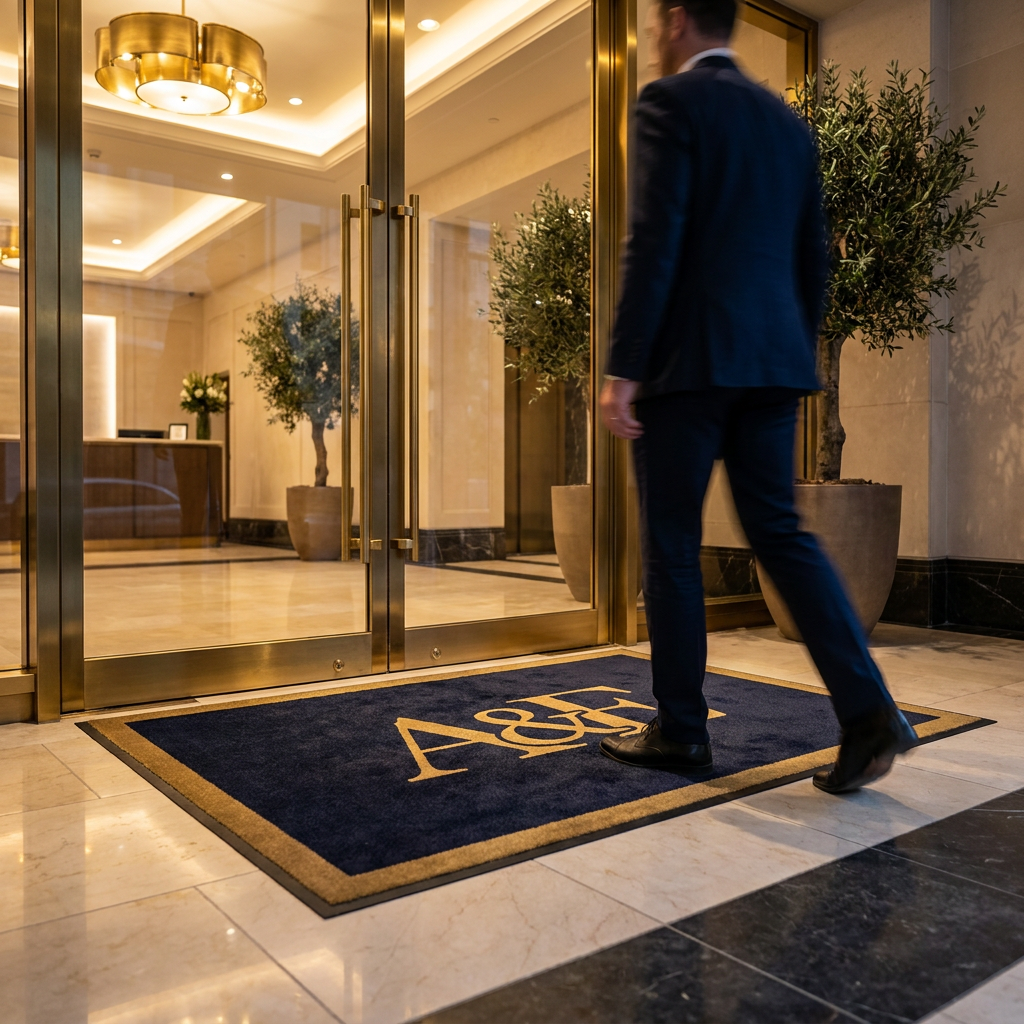
Not all custom mats are the same, and the differences matter more than most buyers expect. Here's a quick breakdown:
| Mat Type | Best For | Key Feature |
|---|---|---|
| Ultraprint HD Entrance Mat | Indoor/outdoor entryways | Photo-quality logo printing |
| Custom Shape Ultraprint Mat | Unique brand shapes (die-cut) | Any shape you want, not just rectangle |
| TreadPop Point-of-Purchase Mat | Retail displays, product areas | Draws attention at the point of sale |
| ValuePop Point-of-Purchase Mat | Budget-friendly retail signage | Cost-effective for promotions |
| Outdoor Logo Mats | Exterior entrances | UV-stabilized inks, weather-resistant |
Most businesses need at least one entrance mat and possibly a secondary display mat near a product zone or reception desk. Think of it as a matting system, not a single purchase.
How Do You Design a Custom Floor Mat With Your Logo? {#how-do-you-design-one}
This is the question we hear most often. Honestly, it's easier than most people expect.
You upload your logo, choose your size and mat type, and preview the final design before you order. Mylogomat's online design tool walks you through the whole process without needing any graphic design background.
Here's how it works:
- Choose your mat type. Use the mat finder tool if you're unsure which one fits your space and use case.
- Upload your artwork. Vector files (AI, EPS, PDF) give you the sharpest results. High-resolution PNGs work well too. Avoid low-res JPEGs, they'll look blurry when scaled up to mat size.
- Set your size and layout. Standard sizes cover most applications, but custom sizing is available.
- Preview and approve. You'll see a digital proof before anything goes to print.
- Place your order. Mylogomat is known for fast turnaround, so you won't be waiting weeks.
One thing worth knowing: if your logo has fine lines or small text, make sure your artwork is at least 300 DPI at the actual print size. High-definition printing on commercial mats can now hit up to 300 DPI equivalent on textile surfaces, which means your logo can look genuinely sharp, not like a blurry approximation.
What's the Best Material for a Personalized Floor Mat? {#whats-the-best-material}
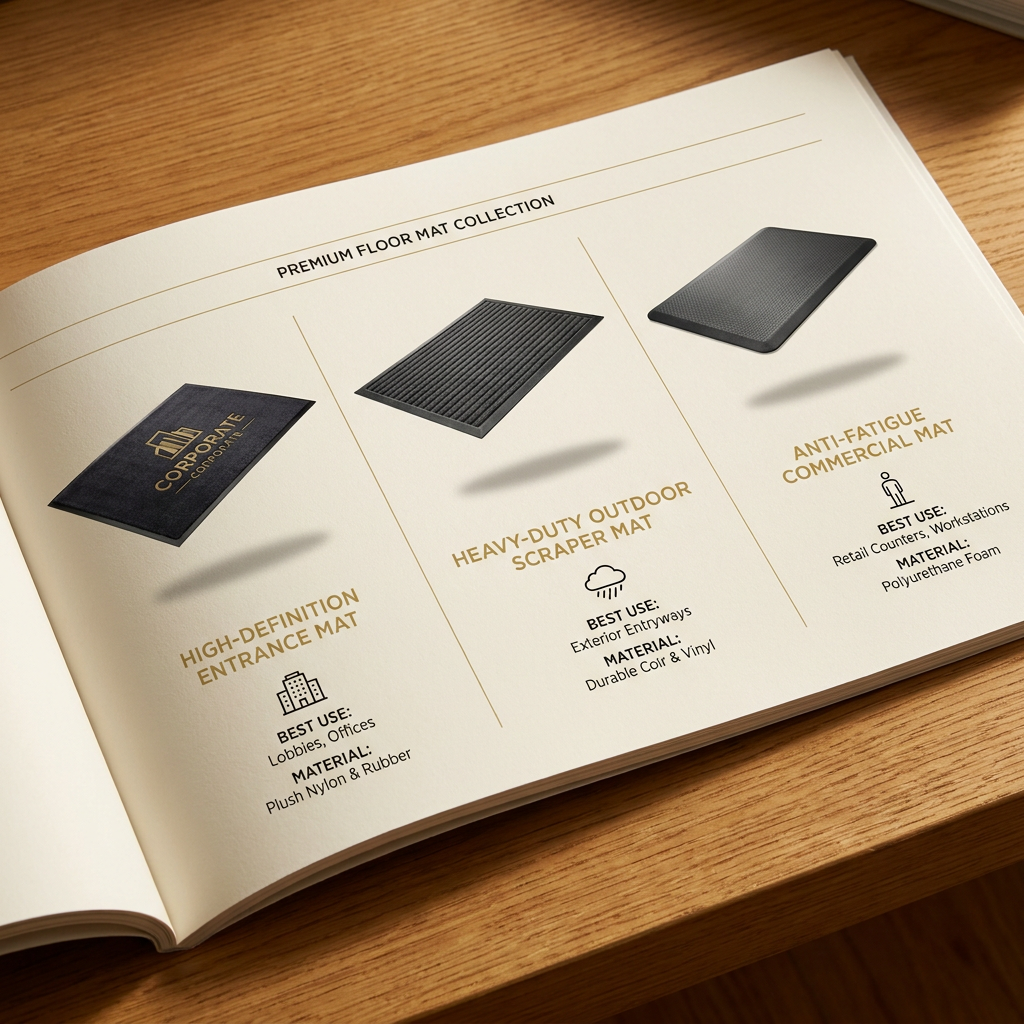
This is where a lot of buyers get tripped up. They compare mats on price and size, but material is what actually determines how the mat performs and how good your logo looks over time.
Nylon fiber is the gold standard for commercial logo mats. It holds dye better than polypropylene, resists crushing under heavy foot traffic, and releases soil more easily when cleaned. If you're in a high-traffic environment like a hotel lobby, a school entrance, or a busy retail store, nylon is the material you want.
Polypropylene is more affordable and works fine in lighter-traffic settings. The trade-off is that colors can fade faster and the pile can mat down more quickly. For backing, rubber is the commercial standard. It keeps the mat in place, prevents curling, and grips hard floors well.
For outdoor mats specifically, look for UV-stabilized inks. Premium outdoor mats can hold their color for 3 or more years in direct sunlight, and that matters a lot if your mat faces south or sits under a glass canopy.
How Long Do Personalized Floor Mats Last? {#how-long-do-they-last}
A quality commercial logo mat lasts about 3 to 5 years under normal use. Some go longer in lower-traffic environments.
Here's the math that makes the investment click. A mid-range commercial logo mat might cost $150 to $300. Spread that over 4 years and you're looking at roughly $0.10 to $0.20 per day for a branded mat that every visitor sees, walks on, and notices. Compare that to a digital ad impression, which lasts a fraction of a second. Your mat makes an impression every time someone walks through the door, including employees, delivery drivers, vendors, and customers.
The PPAI (Promotional Products Association International) has found that branded floor items generate some of the highest impressions per dollar of any promotional product category, specifically because of daily foot traffic exposure.
A few things affect lifespan. Cleaning frequency matters a lot, vacuum regularly and deep-clean based on traffic volume, not just when it looks dirty. Traffic levels obviously play a role too, since a hospital entrance sees very different wear than a boutique clothing shop. UV exposure shortens the life of outdoor mats without UV-stabilized inks. And when the rubber backing starts cracking or curling, that's your signal to replace.
You can browse Mylogomat's portfolio to see how mats hold up in real commercial settings.
The Hidden ROI: Safety, Cleaning Costs, and Brand Value {#the-hidden-roi}
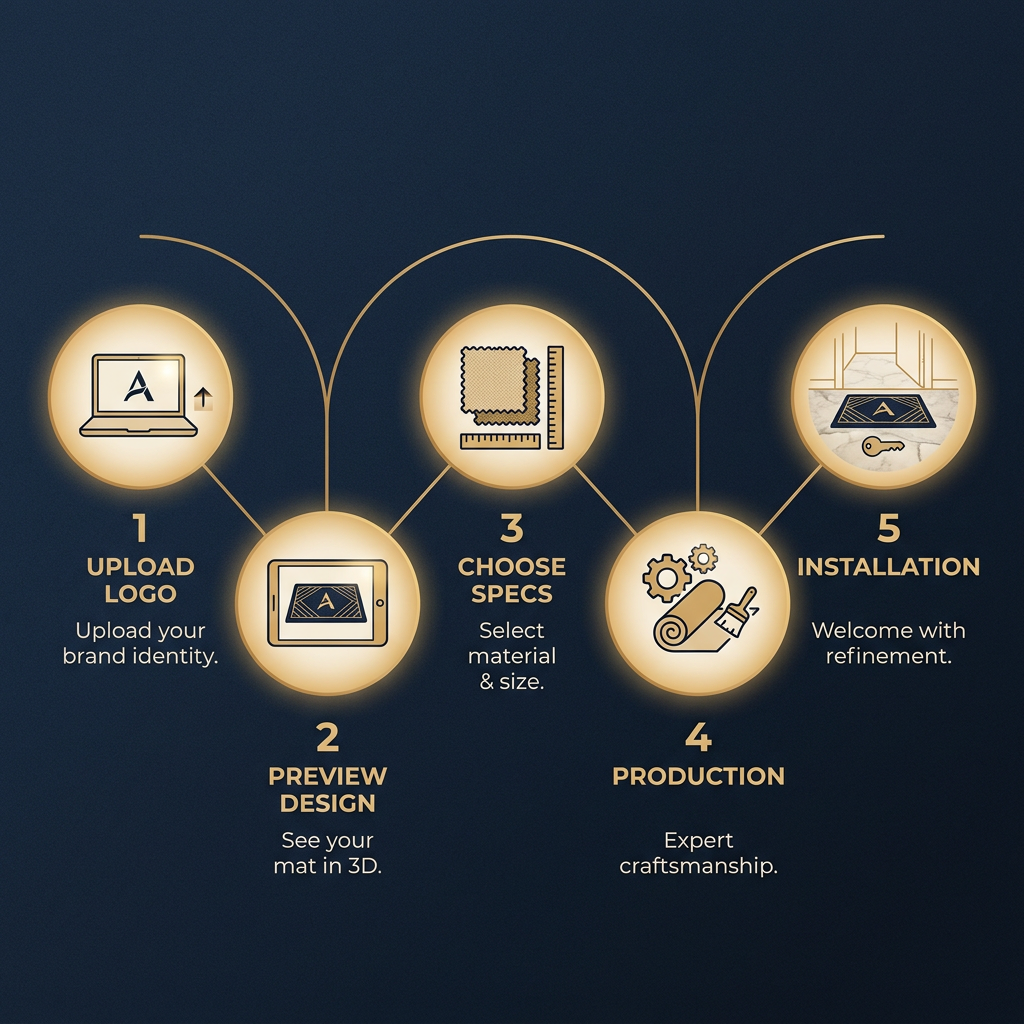
Personalized floor mats actually have three separate ROI levers that most buyers never add up together.
First, safety savings. The National Floor Safety Institute reports that proper entrance matting can reduce slip-and-fall incidents by up to 80%. With OSHA's estimate of $70 billion in annual accident costs across U.S. businesses, even a modest reduction in incidents adds up fast. An entrance mat isn't just décor. It's a liability management tool.
Second, cleaning cost reduction. About 80% of the dirt and moisture that enters a building comes through the entrance, according to the ISSA (Worldwide Cleaning Industry Association). A proper entrance mat captures that debris at the door, and industry estimates suggest this can cut interior cleaning costs by up to 35%. If you're spending $500 a month on commercial cleaning, that's real money.
Third, brand impression value. Your logo mat is always on. No electricity, no subscription, no maintenance. It works around the clock, and every person who enters your space sees it. That's consistent brand exposure that's very hard to match at the same price point.
Stack all three together and the purchase starts to look less like a cost and more like a smart use of budget. Mylogomat's blog post on 20 ways custom logo mats boost your business breaks down even more ways to think about the value.
Indoor vs. Outdoor: Which One Do You Need? {#indoor-vs-outdoor}
The answer depends on where the mat will live and what it'll face.
Indoor mats are designed for controlled environments. They focus on moisture absorption, logo clarity, and comfort underfoot. They're not built to handle UV exposure or standing water. Outdoor mats, on the other hand, need to handle rain, direct sunlight, temperature swings, and heavy debris. They use harder-wearing materials, weather-resistant rubber, and UV-stabilized inks that won't fade after a few seasons.
Some businesses need both: an outdoor mat right at the exterior door to scrape off heavy debris, and an indoor mat just inside to catch any remaining moisture. That layered approach actually works better for keeping your interior floors clean and dry. Honestly, it's the setup we'd recommend for any high-traffic entrance.
Mylogomat's indoor vs. outdoor guide breaks this down in more detail. You can also browse the indoor collection and outdoor collection separately to compare options.
FAQ
How much do personalized floor mats cost? Pricing varies based on size, mat type, and quantity. Entry-level commercial logo mats typically start around $80 to $100. Premium large-format or custom-shape mats can run $200 to $400 or more. The cost-per-day over a 3 to 5 year lifespan is usually well under $0.25, which makes it one of the most cost-efficient branded assets a business can buy.
Can I get a custom floor mat in any shape? Yes, within reason. Mylogomat offers custom-shape mats that can be die-cut to match your logo outline or a specific design. This is popular for mascots, shields, icons, and branded shapes that don't fit a standard rectangle.
What file format should I submit for my logo? Vector files (AI, EPS, or PDF) are ideal. They scale to any size without losing quality. High-resolution PNG files (at least 300 DPI at print size) also work well. Avoid low-resolution JPEGs, especially if your logo has fine details, thin lines, or small text.
Are personalized floor mats safe? Do they slip? Commercial-grade logo mats use rubber backing designed to grip hard floors and prevent sliding. That said, make sure the mat is rated for the surface type you're placing it on (hard floor vs. carpet). A mat that bunches or curls is a trip hazard, so check that the rubber backing stays in good shape.
Can personalized floor mats be used for retail displays, not just entrances? Absolutely. Products like the TreadPop and ValuePop are designed specifically for point-of-purchase areas. They draw customer attention to a product zone, promotion, or branded display, and they work great in grocery stores, pharmacies, and retail showrooms.
How do I know which mat is right for my space? Start with Mylogomat's mat finder tool. Answer a few questions about your space, traffic level, and use case and it points you to the right product. You can also contact their team directly for complex or large-scale projects.
